
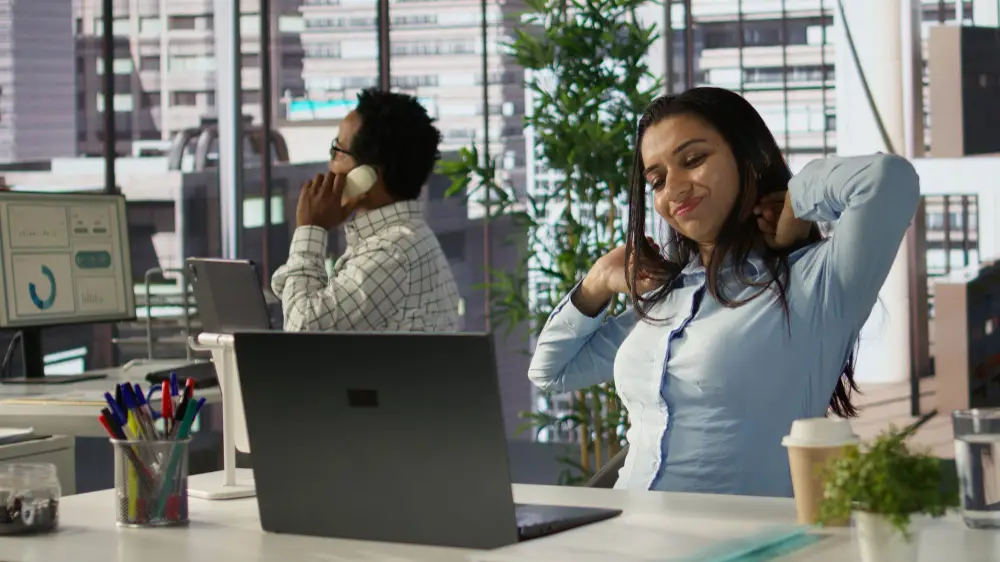
If you spend most of your day at a desk, you have probably noticed that your body has opinions about it. The hips tighten. The shoulders round forward. The neck gets stiff. Lower back pain shows up somewhere between lunch and the end of the day.
The two most common solutions people reach for are stretching and massage. Both help. But they work differently, and for desk workers dealing with the specific patterns that sitting creates, knowing what each one actually does will help you figure out how to use them together.
What Sitting Does to the Body
Before getting into stretching vs massage, it helps to know what you are actually dealing with.
Prolonged sitting puts the hip flexors in a shortened position for hours at a time. Over time, they lose their ability to fully lengthen, which pulls the pelvis forward and increases strain on the lower back. The glutes, which are supposed to be doing a lot of the work of holding you upright, become inhibited. The hamstrings tighten. The chest and shoulders round forward as the upper back loses its natural curvature.
The neck follows. As the upper back rounds, the head drifts forward to compensate, loading the cervical spine. Desk workers often end up with tight upper trapezius muscles, restricted neck rotation, and tension headaches as a result.
This is the pattern. It is very common, and both stretching and massage can address parts of it.
What Stretching Does
Stretching works by lengthening a muscle and holding it in that lengthened position. It can provide real relief, especially for muscles that have been shortened for a long time.
For desk workers, hip flexor stretches, chest openers, and upper trapezius stretches are often recommended. They address some of the most affected areas and can reduce discomfort when done consistently.
The limitation is that stretching works primarily on the muscle itself. It does not address the connective tissue layer, trigger points within the muscle, or the nervous system patterns that have developed around the holding pattern. If a muscle is tight because of an adhesion in the fascia, stretching will not resolve that adhesion. If a muscle is guarding because of a trigger point, stretching may provide temporary relief but the trigger point stays put.
Stretching also requires consistency. You will feel the benefit when you are doing it regularly, and the tightness will return when you stop. For desk workers who are in the same position day after day, stretching helps manage the pattern but does not address the underlying tissue changes that have built up.
What Massage Does
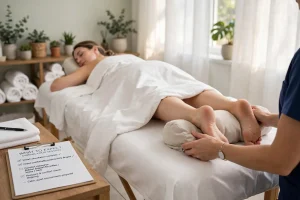
Massage works on the tissue directly. A therapist can identify where the muscle is holding tension, where trigger points have formed, and where the fascia has become restricted, and then work on those specific areas.
For the holding patterns that desk work creates, massage can do things stretching cannot. It can release trigger points in the hip flexors and psoas that have been locked up for years. It can work on the thoracic spine and the muscles along the ribcage that have tightened as the shoulders rounded forward. It can address the suboccipital muscles at the base of the skull that drive a lot of the headaches and neck stiffness desk workers deal with.
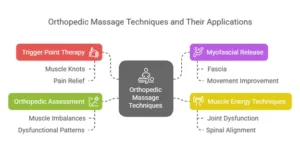
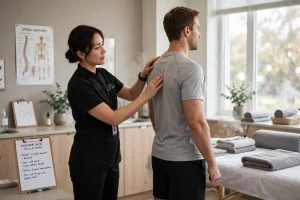
Medical and orthopedic massage takes this further by doing an assessment first, identifying the specific pattern of dysfunction, and building the session around what will actually move things forward. It is not just relaxation work. It is targeted work on the areas that are creating the most dysfunction.
The Nervous System Component
One thing massage does that stretching does not touch is work on the nervous system. Chronic tension in desk workers is often partially driven by an overactivated stress response. The body stays in a state of low-level tension throughout the day, and that tension accumulates in the muscles.
Massage activates the parasympathetic nervous system, brings the body out of that alert state, and creates conditions where the muscle can actually release. That is why a good massage session feels different from a stretch. The release goes deeper and lasts longer.
Which One Works Better
For desk workers, the honest answer is that massage produces more significant results, especially for patterns that have been building for months or years. It addresses the tissue changes directly and can shift patterns that stretching alone cannot touch.
But stretching is not useless. It is a maintenance tool that helps slow the accumulation of tension between massage sessions. If you are getting regular massage and also doing some consistent stretching, you will hold the results of your massage sessions longer and feel better day to day.
The most effective approach for desk workers is to use both, with massage as the main intervention and stretching as the daily habit that supports it.
A Practical Approach
If you have never had massage for your desk posture issues and are dealing with significant tension or pain, starting with a few closer-together sessions will move things along faster than spacing them out right away.
Once the baseline tension has come down and the tissue is responding, monthly sessions tend to be enough for most people to maintain the results.
Pair that with a few key stretches done consistently, some attention to your desk setup, and movement breaks throughout the day, and the pattern starts to break down over time.
The goal is not to white-knuckle through the discomfort of a desk job indefinitely. The body can adapt and recover when it gets the right support. Massage is one of the most direct ways to give it that support, and for desk workers, it is one of the most worth investing in.
Ready to feel better? Learn more about our medical massage in Lancaster, PA, or book your appointment online. You can also call or text (717) 725-9670.