

Introduction
Few things are as frustrating and painful as sciatic nerve pain. It often starts as a dull ache in the lower back or deep in the buttock and then suddenly shoots down the back of the leg like an electric shock.
If you are dealing with this kind of pain, you have probably searched your symptoms online and convinced yourself that you have a herniated disc or a serious spinal problem. Many people immediately worry about MRI scans, injections, or even surgery.
But here is the good news. In many cases, the problem is not coming from the spine at all.
At Focused Care Therapeutic Massage, we often see clients who believe they have sciatica, but their pain is actually caused by a tight muscle condition called Piriformis Syndrome.
The symptoms feel almost identical, but the cause and the treatment are very different.
The Imposter What Is Piriformis Syndrome
The sciatic nerve is the longest and thickest nerve in the body. It starts in the lower spine and travels through the hips and buttocks before running down the legs.
Normally, this nerve passes comfortably underneath a small pear shaped muscle deep in the glutes called the piriformis muscle.
However, when the piriformis becomes tight, inflamed, or goes into spasm, it can press directly on the sciatic nerve.
This often happens due to too much sitting, poor posture, overuse, or muscle imbalance.
Imagine stepping on a garden hose. The water flow gets blocked. In the same way, the nerve signal gets compressed, causing pain, tingling, numbness, or burning sensations down the leg.
This is known as false sciatica. The spine is healthy, but the muscle is squeezing the nerve.
True Sciatica vs Piriformis Syndrome How To Tell The Difference
Only a doctor and proper imaging can give a full medical diagnosis, but there are clear patterns that therapists look for.
True Sciatica Lumbar Nerve Compression
The cause is usually a bulging or herniated disc in the lower spine pressing on the nerve root.
The pain often starts in the lower back and travels all the way down to the foot.
People may also feel numbness or weakness in the leg.
Massage role is supportive. Massage can help relax surrounding muscles and reduce discomfort, but it cannot fix a disc problem.
Piriformis Syndrome Muscle Based Compression
The cause is a tight or spasmed glute muscle compressing the nerve.
The pain is usually centered deep in the buttock and may travel down to the knee, but often not below the calf.
Pain often gets worse after long periods of sitting, driving, or standing.
Massage role is corrective. When the muscle releases, pressure comes off the nerve and symptoms often improve significantly or disappear.
How Therapeutic Massage Treats The Real Problem
If your pain is caused by the piriformis muscle, medication alone usually does not solve it because it does not physically release the muscle.
This is a mechanical problem and it needs a mechanical solution.
Here is how we treat it at our Lancaster clinic.
Deep Gluteal Work
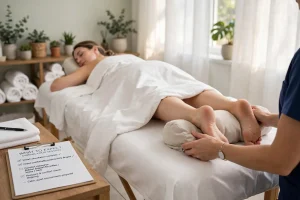
The piriformis sits deep under larger glute muscles. We use slow, targeted pressure to reach this deep layer and encourage the muscle to relax.
This may feel intense but it is very effective for releasing long held tension.
Pin And Stretch Techniques
We may ask you to move your leg while we apply pressure to the muscle.
This technique helps break down adhesions and restores normal muscle flexibility.
It is one of the fastest ways to reduce nerve compression caused by tight muscles.
Hip And Pelvic Mobilization
A tight piriformis is often part of a bigger hip imbalance.
We also treat surrounding hip muscles and joints so the problem does not return once you leave the table.
A Simple At Home Test
Sit on a chair and place the ankle of your painful leg over the opposite knee, creating a figure four shape.
If you feel a deep stretch or familiar ache in the buttock, there is a strong chance your piriformis muscle is involved.
This is actually good news because muscle based pain usually responds very well to therapy.
Tips For Daily Relief
Small lifestyle changes can reduce symptoms between sessions.
Avoid sitting on your wallet if you keep one in your back pocket.
Stand up and move every hour if you work at a desk.
Drink enough water because dehydrated muscles tighten more easily.
Gentle stretching of the hips can also help prevent flare ups.
When To See A Doctor
While therapeutic massage is very effective for muscle based sciatic pain, you should see a doctor if you experience:
Numbness in the inner thighs or groin area
Loss of bladder or bowel control
Severe weakness in the leg or foot drop
Pain after a serious fall or accident
These may indicate a spinal or neurological condition that needs medical care first.
Conclusion And Call To Action
You do not have to live with shooting pain down your leg. Many people suffer for years thinking they have a serious spinal problem when the real issue is simply a tight muscle.
If your sciatica is actually piriformis syndrome, you do not need surgery. You need focused, targeted bodywork.
At Focused Care Therapeutic Massage, we assess your movement, identify the real source of tension, and apply clinical techniques designed for long term relief.
If you suspect your pain may be muscle related, book a targeted therapy session today and take the first step toward walking, driving, and living without pain again.
Looking for relief in Lancaster? See how our medical massage in Lancaster, PA can help, then schedule your session online or call (717) 725-9670.