


You train, you work on your feet, or you play hard on the weekends — and your body keeps the score.
Tight calves that never quite loosen, a shoulder that complains every time you lift, soreness that lingers days longer than it should. Sports massage is built for exactly that: hands-on work aimed at keeping active bodies moving, recovering, and performing.
At Focused Care Therapeutic Massage in Lancaster, PA, sports massage is led by Jean Kark, LMT, NMCT, MMT, in a clinical setting focused on outcomes — not a spa add-on between facials. We work with runners, rec-league players, lifters, and hard-working bodies from across Lancaster County.
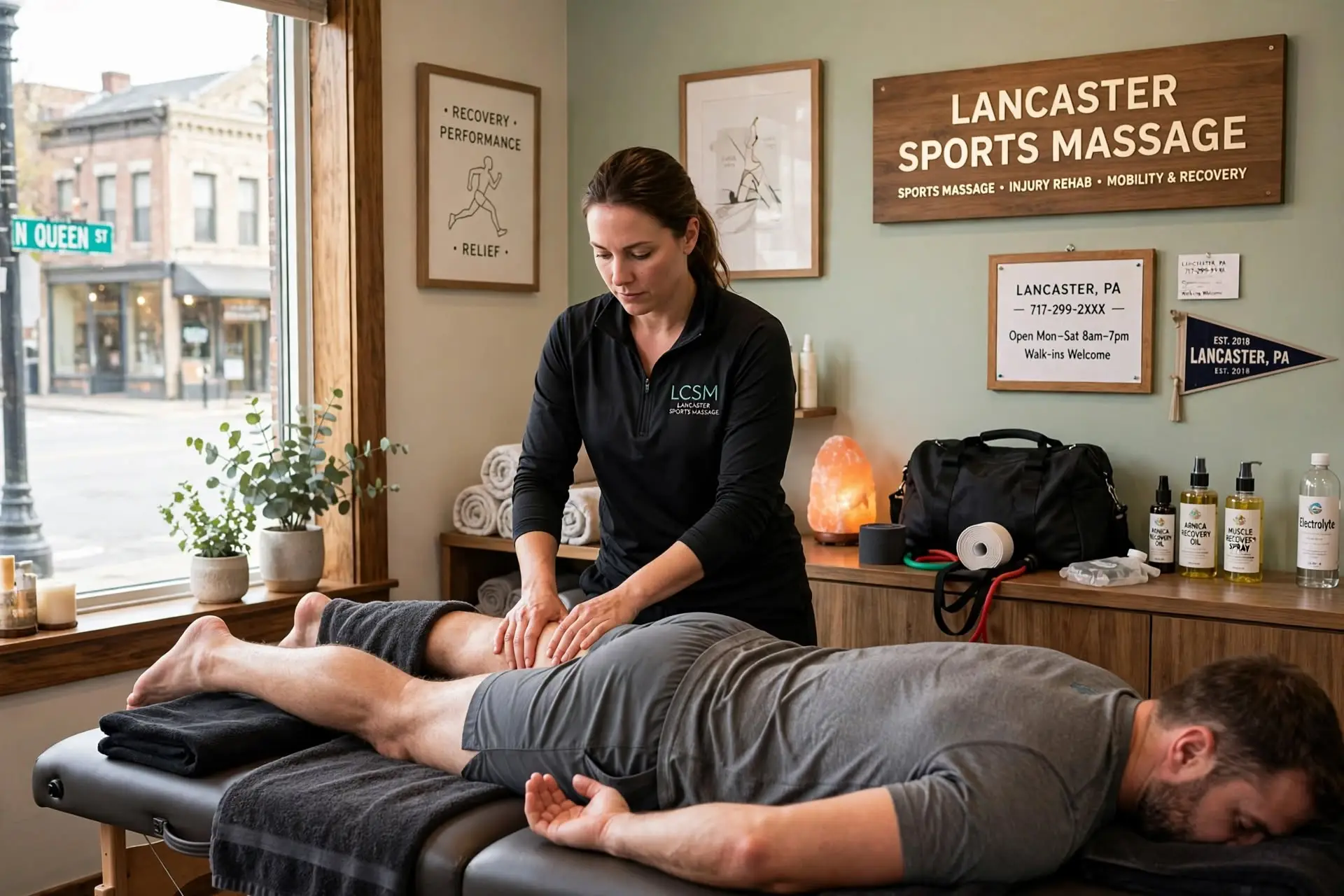
Sports massage is a targeted form of therapeutic massage designed for people who put physical demands on their bodies. It combines techniques like deep tissue work, trigger point therapy, myofascial release, and assisted stretching — chosen session by session based on what your body is doing and what it needs. Unlike a relaxation massage, every sports massage starts with an assessment: what you do, where it hurts, and what you’re training or working toward.
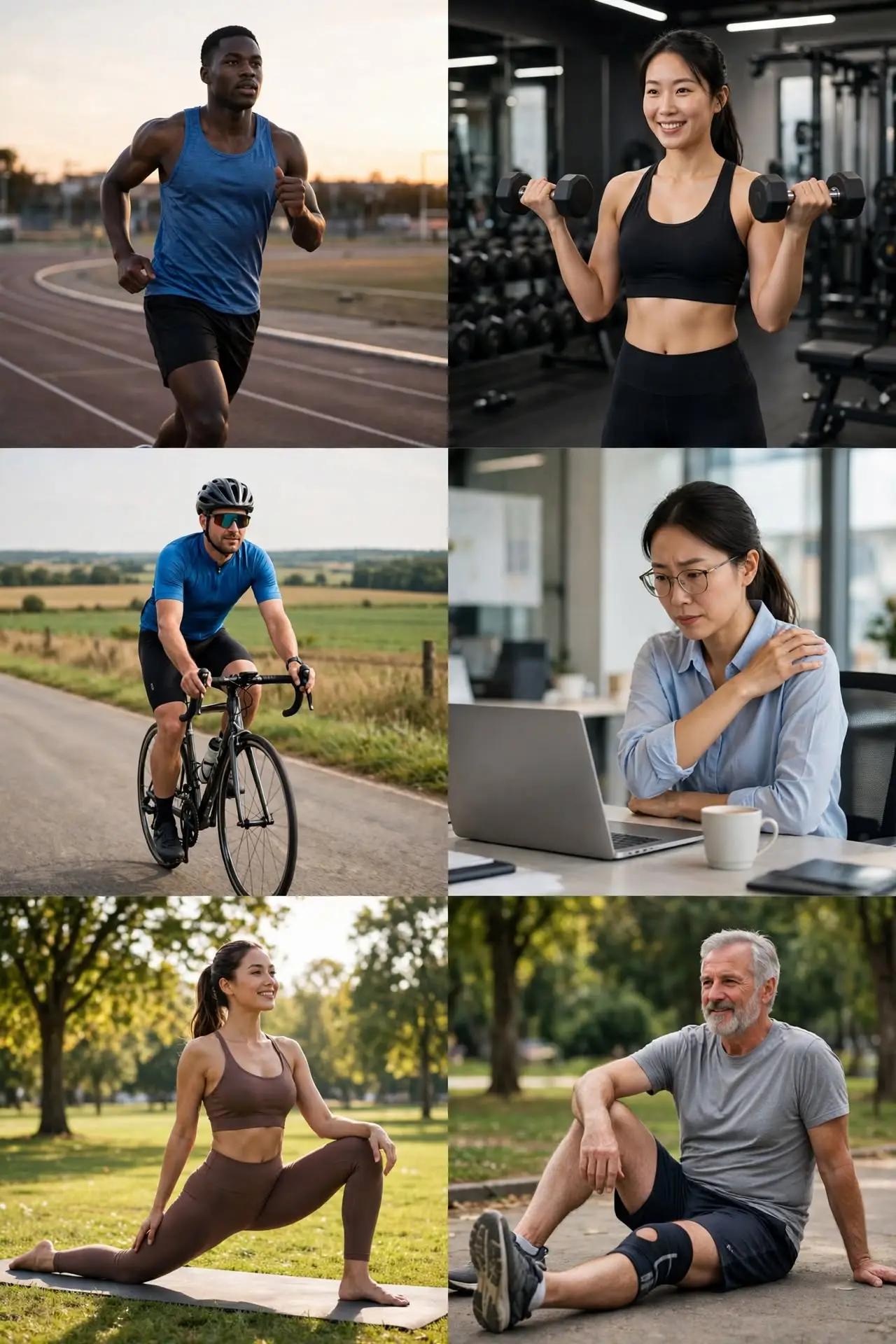
Sports massage is for anyone whose body takes a beating on a regular basis — not just competitive athletes. In Lancaster, that includes:
If your muscles are your tools — for sport or for work — sports massage is maintenance for those tools.
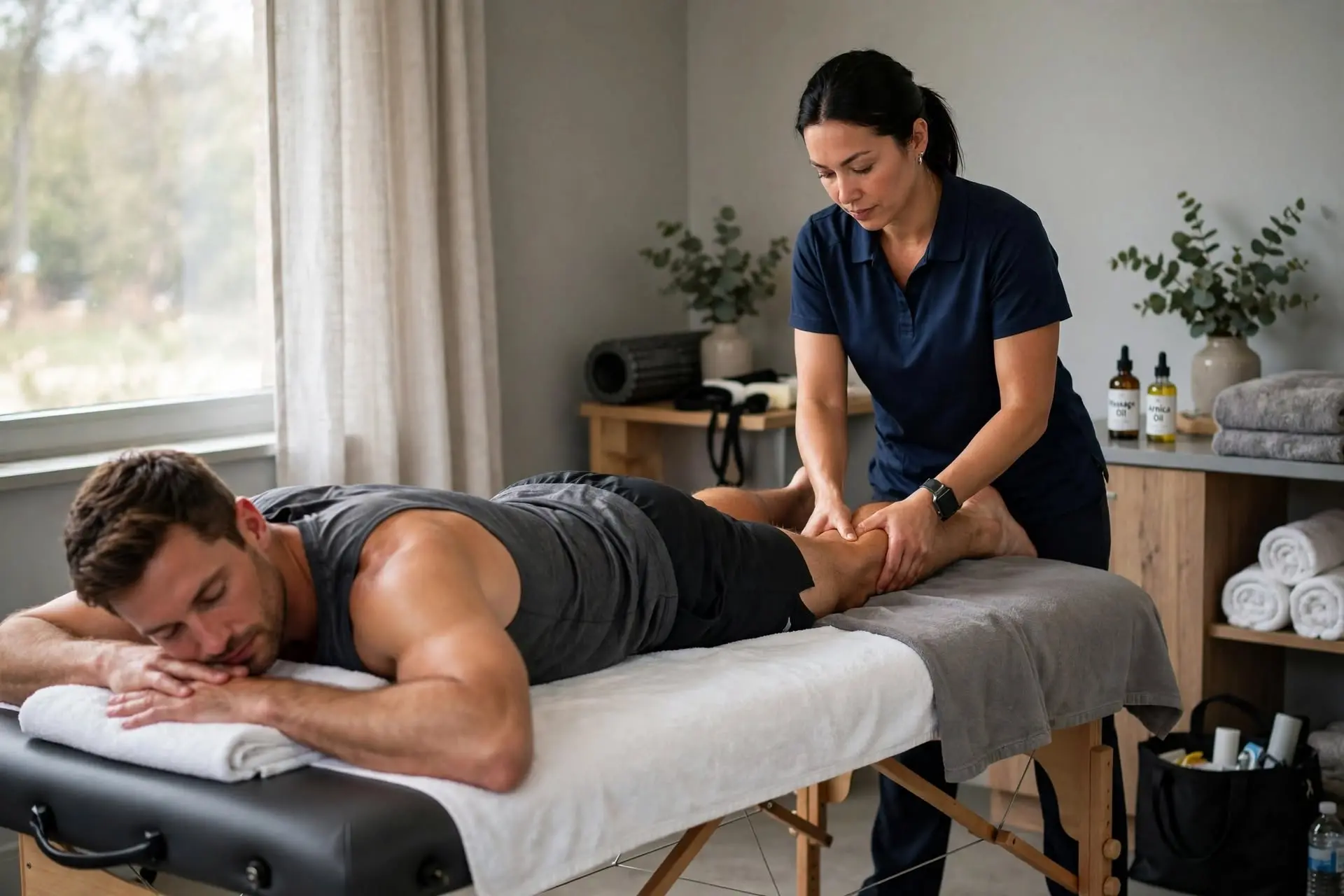
Your first visit starts with an intake and assessment: your training or work routine, current problem areas, injury history, and any upcoming events or deadlines. Then the session itself is built around that picture — not a fixed routine.
Pressure is adjusted to the goal. Pre-event work stays lighter and stimulating; recovery work can go deeper. Your therapist will check in on pressure throughout — effective sports massage shouldn’t leave you wrecked for days.
To release chronically tight muscle groups.
For the specific knots that refer pain elsewhere.
To address the connective tissue restrictions that limit range of motion.
To restore mobility where muscles have shortened.
Sports massage is maintenance and support care. Clients come to Focused Care for help managing:
Overuse patterns from repetitive stride mechanics.
Calf and anterior leg tension common in runners.
Foot and calf work as part of a broader care plan.
Rotator cuff and upper-back tension from overhead or lifting movements.
From lifting, sitting-then-sprinting, or manual labor.
Delayed-onset soreness after training or an event.
General stiffness and reduced range of motion — when the body just isn’t moving the way it should — is one of the most common reasons clients book.
Important: Sports massage supports recovery; it doesn’t replace medical care. Acute injuries — suspected tears, fractures, or anything with significant swelling — should be evaluated by a medical professional first. We work alongside your care plan, and we’ll tell you honestly when something needs a doctor before it needs a massage table.
| Sports Massage | Deep Tissue Massage | |
|---|---|---|
| Goal | Performance, recovery, and injury support for active bodies | Release of chronic tension and knots anywhere in the body |
| Approach | Assessment-driven; techniques chosen per session around your activity | Systematic deep work through problem muscle groups |
| Timing matters | Yes — pre-event, post-event, and maintenance phases differ | Less timing-sensitive |
| Includes | Trigger point, myofascial release, assisted stretching | Stripping, compression, friction, trigger point |
| Best for | Athletes, physically demanding jobs, active lifestyles | Desk-related tension, chronic knots, general deep work |
Many clients use both: deep tissue for the chronic tension baseline, sports massage around training cycles and events. Not sure which fits? Call (717) 725-9670 — we’ll point you to the right session, even if it’s not with us.
A day or two before competition or a big physical effort. Shorter, lighter, and stimulating — the goal is to wake muscles up, not break them down. Deep, soreness-inducing work right before an event is counterproductive.
Ideally within 24–72 hours after. Addresses what the effort left behind: soreness, tightness, and restricted movement. This is where deeper recovery work belongs.
Regular sessions during training — where the real value compounds, catching small restrictions before they become injuries that cost you weeks.
It depends on your training load. Athletes in active training or physical workers in demanding stretches often benefit from sessions every 1–2 weeks. Weekend athletes and active adults maintaining general mobility typically do well every 3–4 weeks. Around a specific event, a session the week before and one within a few days after is a common pattern. Your therapist will give you an honest recommendation at your first visit — including telling you when you don’t need to come back as often.
Your session is built around an assessment and a treatment plan — outcomes first, relaxation second.
Led by Jean Kark, LMT, NMCT, MMT, with training in medical, orthopedic, and integrative techniques.
Medical massage and orthopedic work are offered in-house, so your care can continue under one roof instead of a referral to a stranger.
Rated 5.0 on Google by Lancaster-area clients.
It can be intense — effective sports work goes deeper than relaxation massage. But “no pain, no gain” isn’t the rule; your therapist adjusts pressure throughout, and the goal is productive intensity, not suffering. You shouldn’t be wrecked for days afterward.
No. If your work or lifestyle puts repeated physical demands on your body — construction, nursing, warehouse work, serious gardening — you qualify. The techniques serve the demand, not the jersey.
A lighter pre-event session a day or two before works well. Avoid deep, intense work in the 48 hours before competition — it can leave temporary soreness that costs you performance.
Both, within limits. It supports recovery from overuse patterns and minor strains as part of a care plan. Acute injuries — suspected tears, fractures, significant swelling — need medical evaluation first.
Athletic shorts and a sports bra or tank work well, since sports massage often includes assisted stretching and works through larger ranges of motion. You’ll be professionally draped throughout.
Chain sports massages tend to be a fixed routine with “sports” in the name. Here, every session starts with an assessment of your activity, problem areas, and goals — then the techniques are chosen for that picture. Clinical, not scripted.
Booking your massage session has never been easier. Choose from our selection of
therapeutic treatments and schedule a time that works best for you. We’re here to help
you on your healing journey.
Sessions are available at our clinic at 274A Granite Run Dr, Lancaster, PA 17601. Book online, or call if you’d prefer to talk through your situation first.